My Day Starts Differently Now
My working day used to start with collecting information.
Check Slack, review alerts, open Jira, find pull requests waiting for review, and figure out what changed overnight.
Nothing particularly complicated. Just a collection of small tasks consuming time before actual engineering work begins.
Now I simply say, "Good morning."
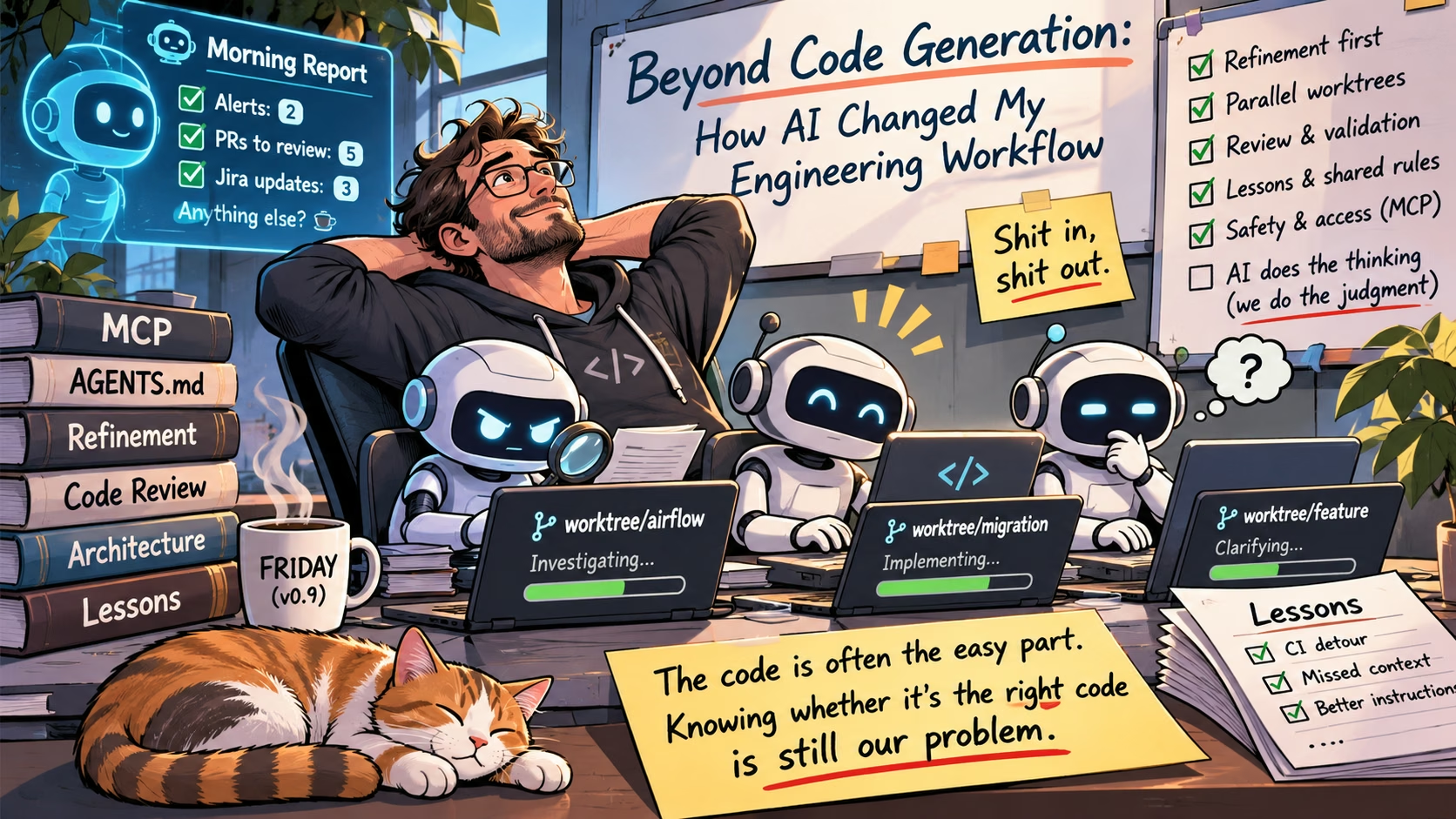
An AI assistant uses connected MCP tools to prepare a report: important alerts, pending reviews, ticket updates, and anything that might require my attention.
I've adjusted the rules several times to reduce noise and improve relevance. It's not autonomous yet. I still trigger it manually.
Think of it as Tony Stark's FRIDAY, except mine occasionally needs reminding not to write a novel.
Instead of spending time collecting information, I start by making decisions based on it.
The same principle now applies to development.
Three Agents, Three Worktrees
I work with a monorepo spanning several projects, combining Python, JavaScript, TypeScript, Terraform, Docker, and other infrastructure tooling.
Previously, handling a ticket meant investigating the code, understanding dependencies, planning changes, implementing them, testing, and reviewing the result.
A typical refinement alone took 30–60 minutes. Database migrations could easily add another 20 minutes of investigation.
Then came the next ticket.
Everything was mostly sequential.
Today, I can start three AI sessions in separate Git worktrees, each working on a different ticket.
The first agent investigates while I'm assigning work to the second. By the time I finish explaining the third task, the first refinement may already be ready.
Initial investigations often take 2–10 minutes, depending on complexity. That's investigation time, not the time required to review and approve the result.
I review proposals, challenge assumptions, clarify requirements, and approve the next steps. Then the agents move to implementation.
Meanwhile, I can attend meetings, discuss architecture, or work on something entirely different.
Recently, while discussing this approach, one agent was analyzing Airflow DAG performance and alerts. Another was validating a historical data migration.
I was having a conversation.
I could just as easily have been eating lunch.
The improvement isn't simply faster code generation. It's that several tasks can progress without my continuous involvement.
Git worktrees isolate code changes, although shared dependencies and integration conflicts still exist.
And three agents don't mean three times the productivity.
They can implement in parallel. I still review their results one at a time.
The bottleneck hasn't disappeared. It has moved.
Refinement Before Implementation
Our workflow has one important rule:
No implementation before refinement.
Shared and project-specific instructions in AGENTS.md require an agent to investigate the current state, describe the target state, propose an approach, and identify missing information.
Only after reviewing and approving that proposal do I allow implementation.
Sometimes I change the architecture. Sometimes the agent asks questions instead of proposing a solution.
That's useful.
Jira tickets aren't always equally detailed. Some clearly describe the expected result. Others contain little more than a title.
We're improving ticket preparation too. An author describes the desired outcome, AI gathers available context through MCP tools and prepares a draft, and the author reviews and approves it.
But AI cannot reliably invent business requirements nobody has defined.
Shit in, shit out. That was true before AI, too.
When Humans Break the Workflow
We had an interesting case.
A ticket was created, updated, assigned for development, and updated again.
The refinement was completed and approved. Implementation proceeded.
Before pushing the changes, I followed another rule: ask the agent to compare the implementation against the current ticket one more time.
Its response surprised me.
Part of the requested functionality was still missing.
The ticket description had changed during refinement, introducing roughly 300 lines of additional work that weren't included in the estimate.
I checked Jira history. The agent was right.
The problem wasn't coding quality. The requirements had changed without the approval process catching up.
Approval belongs to a specific set of requirements, not to a ticket forever.
AI didn't prevent the human mistake. But a final validation caught it before the code was pushed.
Apparently, software development remains a human activity.
Agents Make Mistakes. So Do We.
AI agents can be remarkably creative when solving the wrong problem.
I've seen one investigate an interesting CI anomaly instead of answering a simple question. Another proposed a custom workaround without first checking the external system's documentation.
Others missed important pull request discussions or reviewed only the changed lines without understanding the surrounding code.
Instead of repeatedly correcting the same behavior, I started recording lessons.
Each report describes the incident, root cause, lesson, scope, and verification.
Other developers contribute observations too.
We look for recurring patterns, discard subjective preferences, test improvements locally, and incorporate useful changes into shared or project-specific rules.
The reports themselves don't automatically become instructions.
Not every mistake deserves a global rule. Otherwise, we'd eventually need an AI agent just to interpret the instructions given to the other agents.
One particularly useful lesson:
Smaller, clearly bounded tasks are easier for agents to complete correctly.
Long sessions accumulate context, intermediate decisions, and distractions. Smaller tasks reduce that risk, although excessive decomposition creates coordination overhead.
And instructions aren't security boundaries.
For production diagnostics, our MCP integrations use technically enforced Read-Only access. Risky operations require human approval.
We've also learned that local environments can have unexpected external side effects.
A clever agent with the wrong credentials can create a remarkably efficient incident.
The New Bottleneck Is Engineering Judgment
With implementation running in parallel, my limitations have changed.
I need enough well-defined tickets.
I need to maintain context across several tasks.
And I need time to review proposed solutions and implementations carefully.
That's not trivial.
Holding the context of a complex Epic while supervising two or three other tasks is mentally demanding.
Not everything can be delegated equally, either.
For a straightforward refactoring, I can define the architectural boundaries and let an agent propose the subtasks.
But a complex Epic involving infrastructure, migrations, dependencies, and multiple deliverables requires deeper architectural judgment.
I can ask AI to analyze alternatives. I still decide how the work should be divided and delivered.
The same applies to code review.
Our AI review process checks whether changes satisfy the ticket, considers relevant documentation, and identifies unrelated modifications.
I still review the implementation, but can focus more on correctness and architectural decisions instead of mechanical details.
Tests, acceptance criteria, and realistic validation data remain essential. For migrations, the result must also be verified against the expected business outcome.
This is where engineering experience matters.
Three powerful agents don't compensate for missing engineering judgment. They can just make the consequences of poor decisions arrive faster.
That's also why I invest time in MCP integrations, shared instructions, review processes, and architectural documentation.
These aren't just tools for my own productivity. They're reusable capabilities that other engineers can benefit from.
To me, seniority isn't only about solving difficult problems yourself. It's about organizing work, distributing responsibilities, reducing repetitive effort, and making it easier for others to deliver.
The Takeaway
AI hasn't removed engineering from my work.
I still analyze requirements, design solutions, review implementations, validate assumptions, and take responsibility for the result.
I just don't need to write every line of code myself.
I'm not claiming a threefold productivity increase. I don't have measurements proving that.
What I have is a practical workflow where several tasks progress simultaneously without demanding my constant attention.
AI hasn't replaced engineering experience. It has made that experience more important when deciding what to delegate, how to validate it, and when to intervene.
The code is often the easy part now.
Knowing whether it's the right code is still our problem.