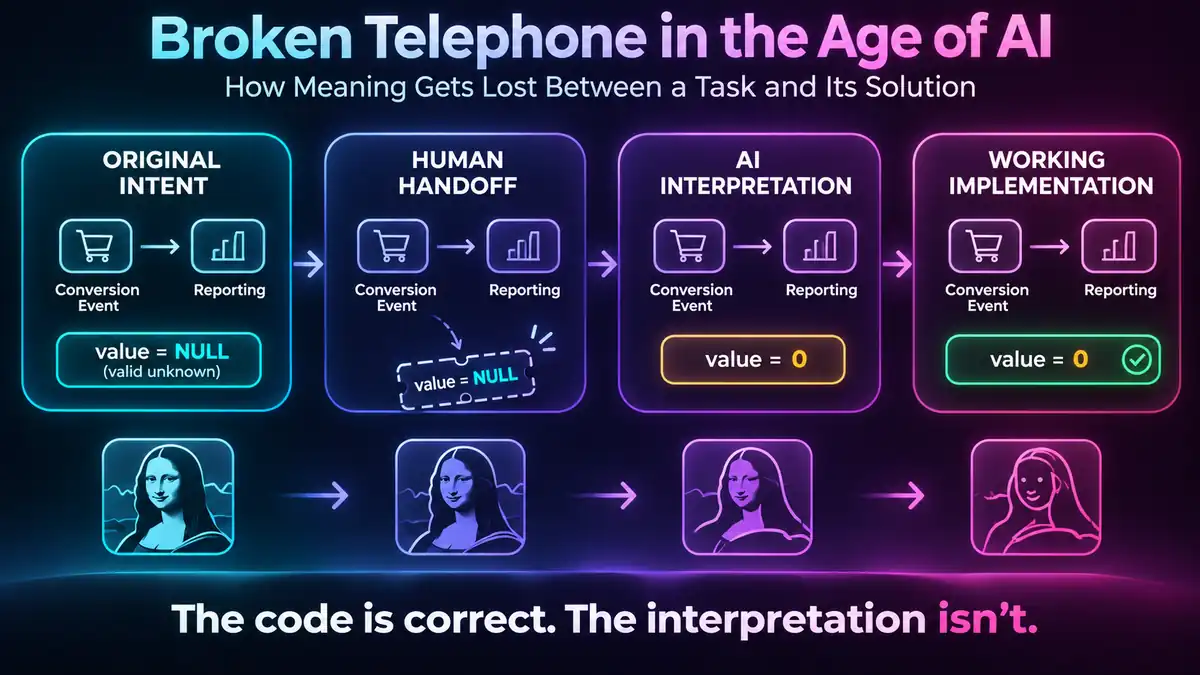
Draw the Mona Lisa
Imagine an exercise. Several people stand in a line, one behind the other. The first person draws on a sheet of paper held against the second person's back. The second person feels the marker moving and tries to reproduce the drawing on a sheet of paper held against the third person's back. The process continues to the end of the line.
The original task is the “Mona Lisa.” By the end of the line, the result is an entirely different drawing, no longer resembling the original.
But there is a more interesting detail: the first person does not even have to draw a portrait. They could simply write “Mona Lisa.” That is another way of communicating an idea. Except now the next person has to recognize letters from movements on their back, work out what they mean, and decide what to pass on.
Everyone in the line may be trying their best. No one has to be foolish or incompetent. Yet the final result is not what the first person intended.
Why? Because between the original idea and the outcome lies a chain of communication and interpretation. The recipient does not work with the sender's intention directly, but with their own understanding of it.
Too Often, We Leave Important Things Unspoken
This exercise is a useful analogy for how tasks are communicated in everyday work.
When we say “build a report,” “optimize this query,” or “refactor this service,” we assume the meaning is clear. But everyone has their own, usually incomplete, picture: there are things we know, things we take for granted, and things we do not even realize we are missing. Only part of that picture makes it into the written task. And that is not always because someone described it badly. Sometimes the person assigning the task does not know about an important constraint either.
Information can be distorted in several ways. A detail may never be passed on. It may be communicated but understood differently by the recipient. Or a gap may be quietly filled with an assumption. At the next stage, that assumption can look like part of the original requirement.
This is not just an AI problem. People also communicate their thoughts imprecisely, whether in conversation, documentation, tickets, or meetings. Even a detailed description does not guarantee a shared interpretation: participants have different experiences and different mental models of the system.
We can and should ask questions. When receiving a task, it is better to clarify something one more time than confidently head in the wrong direction. But questions are no guarantee either: we can only ask about things we realize might need clarification. A crucial detail may never come up simply because someone forgot it or considered it obvious. No bad intentions, and not necessarily an obvious mistake by any one person.
That is why communicating information accurately and checking that it has been understood are part of engineering work, not a formality before writing code.
Now Put AI in the Middle of the Line
An AI assistant receives a task description and tries to help. It can draw on knowledge of many technologies, architectural approaches, and implementation strategies. It can suggest alternatives, spot contradictions, point to unfamiliar tools, and accelerate investigation.
But it is not guaranteed to have the full context: unwritten project conventions, the history of past compromises, hidden dependencies, or the actual motivations of the person requesting the change. Even when information is available, it can be interpreted incorrectly. A large context window does not, by itself, guarantee that what matters will be understood or prioritized correctly.
Now imagine the chain: a person unintentionally leaves out a detail → AI fills the gap with a plausible assumption → another person takes the coherent explanation as an accurate description of the task → the next stage of work builds on that interpretation.
AI can ask a clarifying question and identify contradictions. But, like a human, it does not always know which specific piece of information is missing. An individual answer may be perfectly reasonable while the chain as a whole gradually drifts.
The problem is not merely that information has been lost. An unverified interpretation gradually becomes the new “original requirement.”
That distortion can be hard to spot: a polished architecture description, a convincing diagram, and working code do not reveal which detail was lost earlier.
An Almost Correct Solution Can Be the Hardest Error to Notice
Imagine a task: send conversion data to an external analytics system. The monetary value of a conversion is not always known. The original meaning is straightforward: send a numeric value when it is known, and leave it unknown otherwise. “Unknown” and “zero” are different values. Assume that the destination system accepts both zero and a missing value.
That distinction was mentioned during the initial discussion. But the description passed to the next person only says “send conversions and their values.” A developer gives AI the task description and the input data schema. The assistant sees a nullable field and suggests replacing missing values with zero to make it easier to construct a numeric payload. The suggestion looks reasonable. Known values are transmitted correctly, the integration works, and tests with ordinary data pass.
Later, it becomes clear that unknown conversion values now appear in the destination system as conversions with a confirmed value of zero. The transmission succeeded and the data is formally valid, but its meaning has changed.
Each stage involved a small shift: the distinction did not make it into the task description, the absence of a value was interpreted as zero, and the assumption was encoded in the implementation. Nobody asked for the data to be distorted. Everyone was working on the same task, but one important distinction was lost.
An engineer could, of course, have checked the meaning of the field, the integration contract, and the scenario where the value is unknown. But first, someone had to recognize that these were questions worth asking. This is a hypothetical example. Its purpose is not to demonstrate a flaw in any particular technology, but to show how meaning can change as a task is passed along.
How AI Can Lead Us Away from the Original Goal
Context is not lost only between people in a conversation. It can drift during the work itself: each new answer builds on the previous interpretation while the original objective gradually fades from view.
Suppose the task is to investigate an unstable data pipeline. During the investigation, a slow SQL query is discovered. AI suggests optimizing it, then changing the data model, then performing a migration. Each step may be technically sound. Yet the original failure remains unexplained.
People can also get drawn into an interesting side issue. AI is no exception; with AI, we can simply make many more steps in the wrong direction much faster. A similar effect occurs when someone says “let's introduce microservices” and the assistant immediately proposes an architecture instead of asking, “What problem are we trying to solve?”
That is why it helps to keep the original objective, confirmed facts, and list of hypotheses explicit when working with AI, and to revisit them after any significant detour. This helps, but does not guarantee that nothing important has been missed.
Engineering Maturity Matters More Than Typing Speed
AI makes it faster to write, test, and modify code. But the ability to generate an implementation is not the same as the ability to choose the right one.
Someone can spend twenty years working with the same technology and never learn to see the consequences of decisions beyond their immediate task. Years of experience alone do not create engineering maturity. AI does not add it automatically either.
Engineering maturity does not mean knowing all the context or never making mistakes. It shows in how someone deals with the unknown: separating facts from assumptions, looking for dependencies, clarifying requirements, evaluating alternatives, and considering the consequences of decisions. Those skills grow through deliberate practice, not merely through time spent in a role.
This does not mean that knowledge of programming languages, runtimes, databases, or infrastructure has become unnecessary. Without technical depth, it is impossible to assess implementations and risks properly. But memorizing method names and syntax is an even poorer measure of engineering ability.
AI should be treated as a tool that also requires investment: providing context, rules, documentation, access to verifiable sources, correcting mistakes, and testing the complete scenario. And we should learn from its outputs rather than simply accepting them.
How to Reduce the Loss of Meaning Along the Way
In the Mona Lisa exercise, each participant passes on only what they managed to perceive. At work, we have an advantage: we can go back to the source and ask again. We should use it. But even ten rounds of clarification cannot guarantee that a detail nobody thought of will come to light.
So the goal is not to write “perfect requirements” once or to eliminate distortion forever. It is to keep checking our understanding against the original objective and challenging our own assumptions:
- Keep the goal explicit: what problem are we solving, and how will we know it is solved?
- Clarify the meaning: do not just repeat the wording; check whether everyone understands the intended outcome in the same way.
- Look for what is missing: examine source documentation, decision history, dependencies, and behavior under failure rather than waiting for everything to be spelled out in the task.
- Separate facts from guesses: what has actually been confirmed, and what have we or the AI merely assumed?
- Test the scenarios: not only the happy path, but also retries, errors, recovery, and other consequences relevant to the task.
- Return to the goal: after investigation, a proof of concept, and implementation, check whether we solved the original problem rather than a convenient interpretation of it.
This is not a universal safeguard. Some details will still be missed, and some errors will only become visible in production. But these checks reduce the risk of a misunderstanding passing unnoticed through the entire chain.
AI can be a very useful participant here: identifying contradictions, suggesting questions, comparing alternatives, and helping test hypotheses. The crucial thing is not to mistake a convincing answer for proof that the task was understood correctly.
Final Thoughts
I am in favor of AI. It helps us investigate, learn, and build solutions faster. But it does not eliminate a natural limitation of human communication: we leave details out, understand the same words differently, and do not always notice when the meaning of a task has shifted along the way.
In the Mona Lisa exercise, each participant faithfully reproduces what they believe they perceived. Something similar happens in engineering: some information is lost, some is interpreted differently, and gaps are filled with assumptions. As a result, an otherwise functional system may produce the wrong outcome because a crucial detail never made it into the implementation.
The faster AI helps us implement solutions, the more important it becomes to preserve the link between the original problem and the result. Clarifying, checking, searching for missing context, and returning to the goal are not obstacles to speed. They are part of engineering work.
Bad code is not the only danger. Sometimes everything works exactly as specified; the problem is that, somewhere along the way, the specification stopped accurately reflecting the original intent.